
“You got that fire in your eyes.”
Those were words used to recruit prospective boys into a Baltimore gang. Would you like to know how I became privy to that information? It was told to me by one of my middle school students. He wouldn’t confirm nor deny it was said to him.
At the time I was teaching at William C. March Middle School. The school was named after the funeral home. It was a charter school located on the campus of Harford Heights Elementary in East Baltimore. In the neighborhood I was born and raised in.
I was coming back home to do GOD’s work.
The school faced extreme challenges. I was aware of some of them. In all honesty, the challenges were similar to those faced by other charter schools. These schools serve a similar demographic in Baltimore City. The common issues are attendance, poor standardized test scores, underutilization of facilities and operational mismanagement.
When they told me what the challenges were, I’m certain I responded with, “I can fix that.” You know that’s the mindset of all teachers. We have that “I can fix it” mindset. Plus, it’s the mindset of a man who needs a job. I would’ve told them that I could’ve fixed anything at the time. “Mr. Dews, our hot water boiler isn’t working.” Before they could’ve finished the statement, “I can fix it.”
Maybe we could’ve “fixed” some things given ample time and the proper support. But we’ll never know.
In November of the 2012–2013 school year, the school announced that our doors would close in June. This decision meant a permanent closure. March Middle was one of four schools slated to be closed within seven months. The news came swiftly.
Everyone was impacted.
The timing could not have been more imperfect for me. My idea of returning home to save kids and positively impact the community was crushed. The morale in the building was decimated. The uncertainty of what was to come next caused strife and anxiety for us all. If they believed our students and parents were uninterested and disengaged before hearing this alarming news, how could they have imagined the rest of the school year?
I’m sure it’s never easy when decisions like this have to be made. Whether these are business decisions or politically influenced, I want to believe these choices are made for the people’s best interest. But that’s just the idealist in me. Unfortunately, I know from personal firsthand experience how the people and communities are devastated by abrupt school closings.
What happens to kids who are abruptly dispersed from their neighborhood schools, given few and some unrealistic options for parents? What new dangers might they have to encounter traversing through different neighborhoods to attend a new school?
What message are you sending the students when you decide to close the school? Are you calling them failures? Are you saying the system failed them? Are you abandoning children who already suffer from abandonment issues?
Are you adding to their trauma?
Most charter schools in Baltimore City are community based with a specific niche. All of the great things that take place in those buildings can’t necessarily be measured. They are not viewed through the same optics as your traditional schools.
Most charter operators create their mission statement based on a particular community need. They then become an anchoring institution in that community. It’s more of a holistic approach with reach that extends far beyond classroom walls. They operate from the perspective that to make the greatest impact on the student they serve, they must also impact the home. The goal is to influence the environment from which the students come.
Over the last two decades, my childhood neighborhood has been impacted by a few school closings. Until I personally experienced it as an employee, I didn’t realize the devastation it causes the community. I guess you could say I was a victim of the “if it don’t impact me, I don’t care about the impact” mentality.
But I can now see clearly the irreparable blight caused by the abandonment of a community. That’s what school closures are. It’s an abandonment of a community. Regardless of any “dollar” amount saved, it’s done at the detriment of human capital.
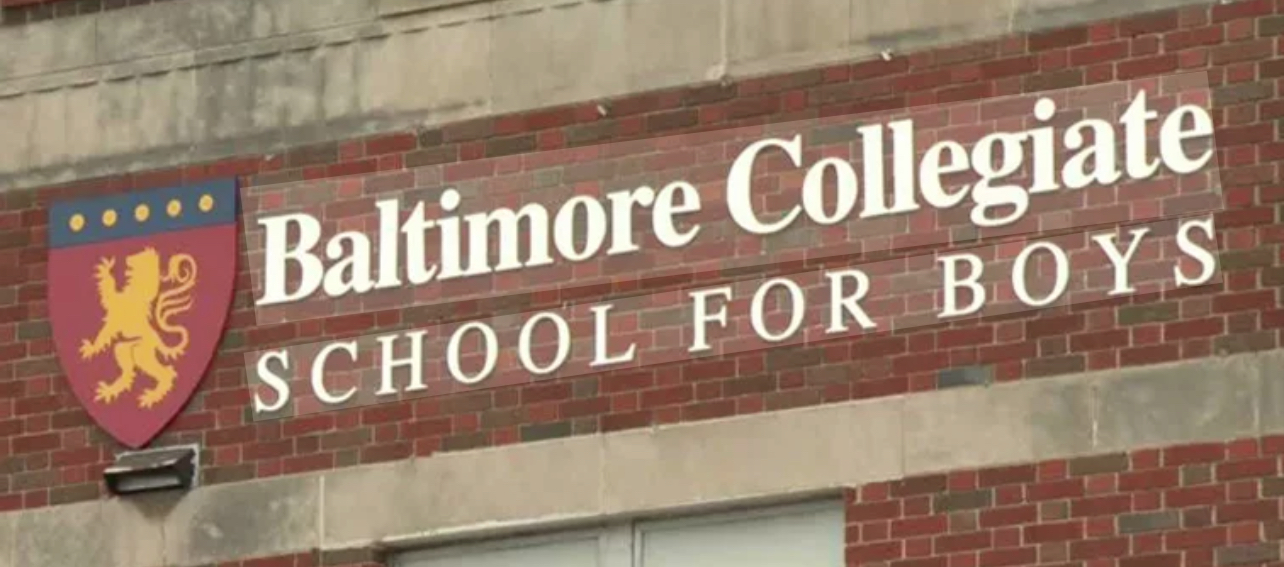
I write this editorial because once again, there’s a school in my childhood neighborhood that North Avenue is considering locking the doors on. It’s the Baltimore Collegiate School for Boys housed at 2525 Kirk Avenue Baltimore, MD 21218.
Its website boasts of a school for boys grades 4–8 which provides the finest liberal arts education possible to Baltimore’s next generation of young men, ensuring they will become global citizens trained to learn, lead and serve our community, nation and world. That’s a noble mission. They also have a 90–95% high school graduation rate for all boys who matriculated through their program. That’s a number more than 15–20% points higher than the national average.
Like many charter schools, the great things they’re doing for the schoolwide community aren’t necessarily measurable by regular noted outcomes. Such as providing crucial nurturing, character development and guidance that keeps boys on track.
This is the type of embrace referenced in the African Proverb: “the child who is not embraced by the village will burn it down to feel its warmth.” They’re doing the work.
The overall impact of the school is seen as positive. The institution interrupts cycles of failure. It provides hope and opportunity for young men of color in Baltimore City. It has the support of its families. Community residents and supporters are demanding it stay open. They want it to fulfil its mission in building future leaders.
Sadly, it is at risk of not having its charter renewed. The reason is due to “not effective” ratings in areas of sustainable metrics. The school has received poor marks in academics and financial management/governance during renewal reviews. They’ve been criticized for administrative shortcomings like data entry errors, missing paperwork and staffing issues. And there are some claims of significant underfunding from City Schools that’s hindering their ability to thrive.
All of these claims may or may not be true. I just read them on the internet.
But let’s say there’s some relevance to these critiques. My question: is this enough to disrupt a community by dismantling one of its anchoring institutions? Is this enough to displace kids?
Can the areas of concern be addressed with support? Can the right changes be made without hurting the students and the community in which it serves?
I’m sure we’d all agree that this one-of-a-kind program is necessary in our city. Don’t abandon the program. Just fix what needs to be fixed. It’s imperative that you do.
When I think back to my personal experience at March Middle School. Of course, I know how I was impacted. I can vividly recall how my family was impacted. It hurts. But I think about the students we left.
I think about the young man who shared with me the statement “you got that fire in your eye.” And I wonder what happened to him. Did he become a part of the gang? Was he already active?
I wonder what happened to all the kids who were school-abandoned by March. Sadly, I know firsthand that many of the young men, from my neighborhood, ended up in prison.
I don’t want to assume the worse outcome for these BCSB scholars. I just know the alternative. I also know the decision to close this school will have an everlasting effect on all parties involved.
Please City Schools, if there is a way, keep the doors of the Baltimore Collegiate School for Boys open. The return on this investment is invaluable.
 Thedewsperspective
Leave a comment